


If you’re under forty in America, you already know the housing story, because you live it. Rent takes a third of your paycheck. Maybe half. The starter home might be available somewhere, but not where you live. And everybody has a theory about why. Corporations bought all the houses. Your generation spends too much on burritos from DoorDash. Interest rates. Inflation. Greedy landlords. Pick your favorite.
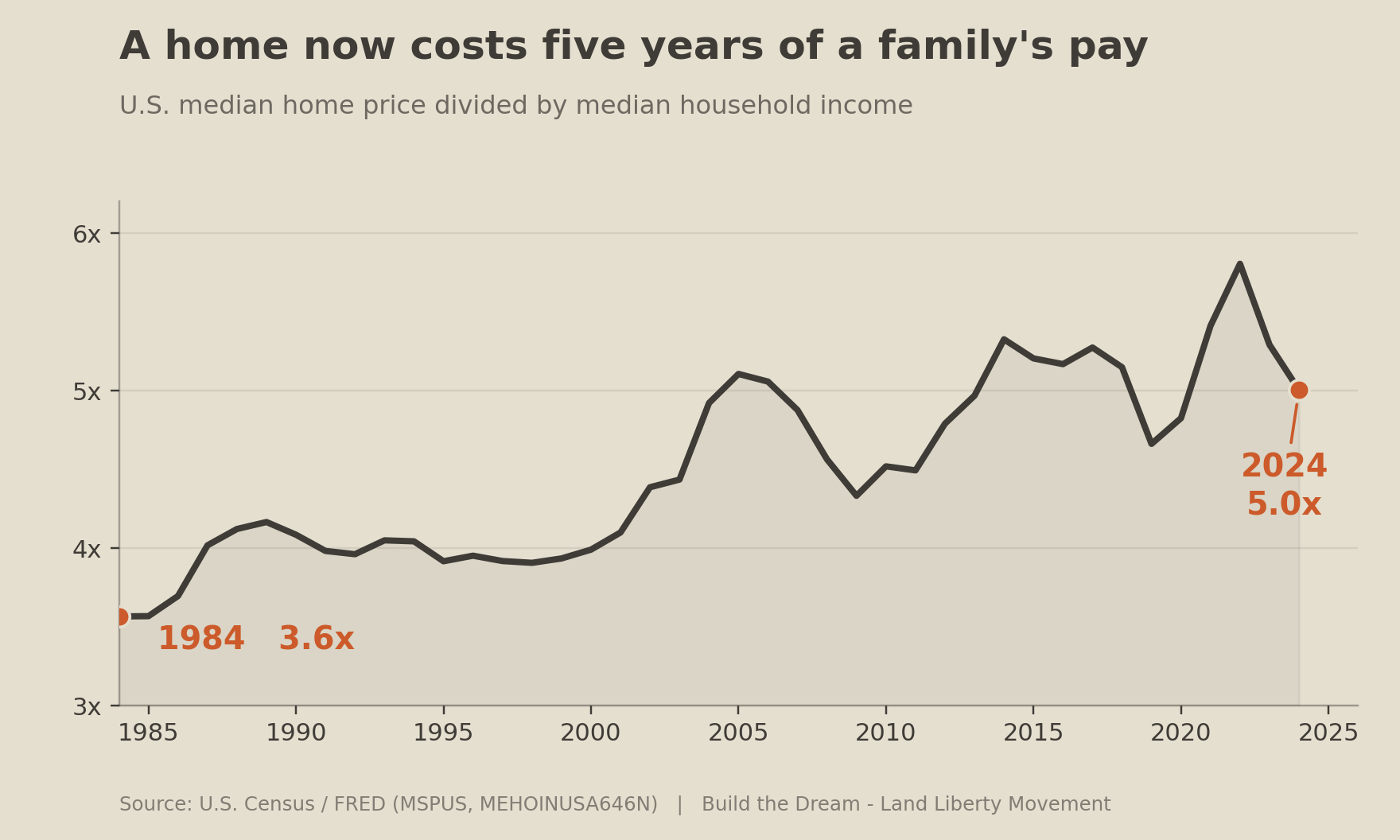
The math your grandfather planned his life around is gone. Source: U.S. Census / FRED.
I’ve spent sixteen years solving big political problems in my home state. Working to make things better for my neighbors. I’ve taken up the challenge of housing because it’s so important to the future of this country, and I’ve been studying the issue for 5 years now.
Today I’m going to tell you what’s actually causing it. Then I’ll show you the way out, because there is one.
Start with what we know for sure. America knows how to build. Our builders are the best in the world. Hand a crew a lot and a permit, and they’ll frame a house in weeks, as good as any house in the world. The skills, materials, and land all exist. Fly across this country and count the empty ground below you; walk through any city, and you’ll find vacant lots and derelict buildings in need of redevelopment. And of course the demand exists. Millions of people want a modest house they can pay for, and they want it badly enough to work decades for it.
So let’s take stock of our housing situation at the highest level. We’ve got willing builders. Lots of land, empty and otherwise. And yet, not enough houses. Scarcity is the starting point for reality, but scarcity like that does not occur naturally. I conclude this because it fails the smell test of what an economy is, which, when you step back away from the abstractions it is basically the processes by which we transform things into products to solve other people’s problems. We do this in billions of different ways, but for some reason, housing is broken. I think someone manufactured the situation we are in.
I think we live in an era of artificial scarcity, especially in housing.
This plays out once you dive into the public policy. You look at the literature and you realize that in most American cities and towns, it is illegal to build a small, cheap house. I mean that literally. What a scandal that goes so unseen in our public discourse. And that’s likely because it isn’t a law that says, “thou salt not build small houses”; it’s all laws by proxy that, in effect, make them illegal.
Start with minimum lot sizes. Your town draws a map, and across most of that map the law says every house must sit on a quarter acre, a half acre, sometimes a full acre or more. This one rule, with a few lines of code, does more damage than every other rule combined. Because land is the biggest cost in housing. When the law forces every home to have a big, expensive lot, the cheap house becomes mathematically impossible. No builder on earth can put a $200,000 on $300,000 of mandatory dirt. So they build what the math allows: the big house, and only the big house. Local governments killed the starter home. Builders just built what they were legally allowed to.
Now stack the rest on top. These are all topics I’ve already explored in previous episodes:
Parking mandates that force builders to use space for parking, or more parking than what makes sense on the ground.
Plot dimension and setback requirements that kill off other designs
Permit processes that run months, sometimes years, and every month adds costs to your dream home.
Public hearings where anyone who already owns a home nearby gets a microphone and a veto over homes for the people who don’t.
More than a quarter of a new home is regulation, spent before a nail is driven.
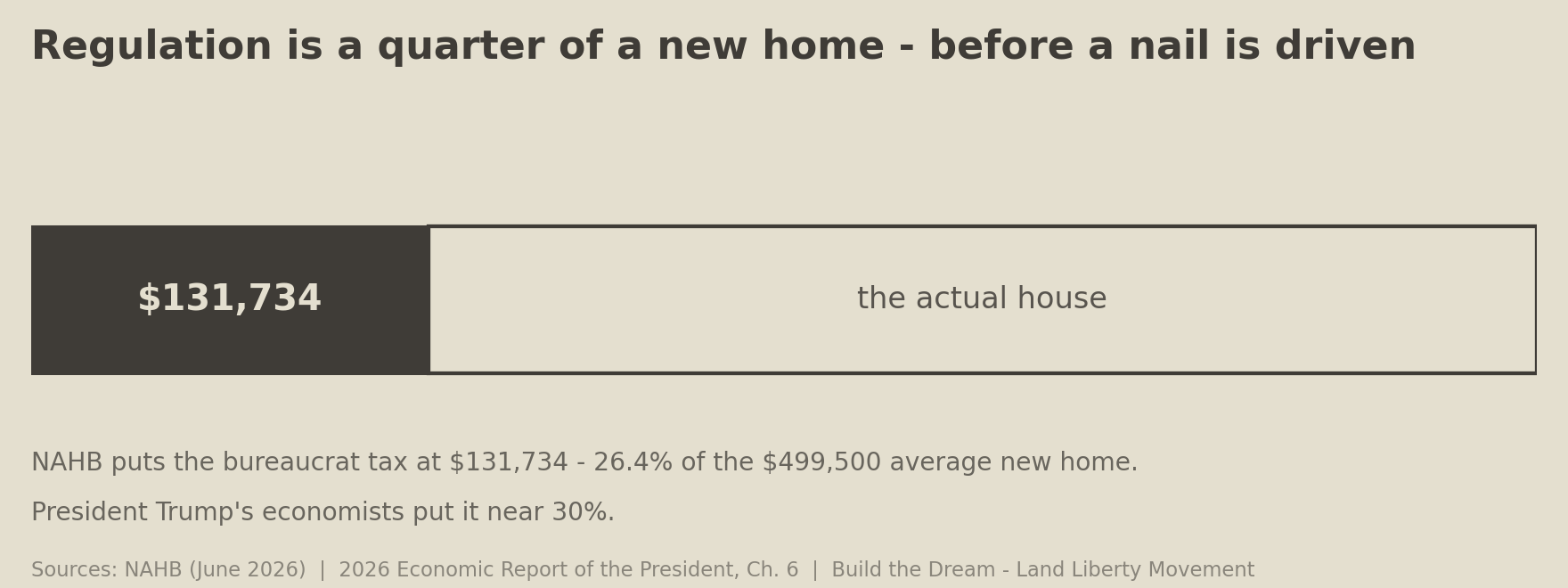
Add up the fees, the studies, the delays, the compliance, and by the homebuilders’ accounting, it comes to $132,000 per new house. About thirty percent of the price. That’s all before a single nail is driven.
You’re paying for this bureaucracy tax – as President Trump’s economists put it – on your shelter. The most fundamental human need. It cannot be that we tax such a need like a luxury and ration it like a privilege. But we do.
Where did all this come from? It’s older than you think. In the 1920s, American cities started drawing maps that dictated what could be built where, and who, in practice, could live near whom. In 1926, the Supreme Court blessed the whole project in a case out of Euclid, Ohio, in an opinion that described the apartment house too close to some other kinds of housing as “a kind of parasite”. That is the actual word the Court used. Parasite. That idea, that ordinary people’s housing is a nuisance to be zoned away from “respectable” neighborhoods, got copied into tens of thousands of local codes. It has been compounding for a hundred years. Every decade the rulebook got thicker. It never once got thinner on its own.
Our country turned on itself; it shut down the pathway to homeownership because it made apartments more scarce, and then it made smaller – cheaper – developments of all kinds nearly extinct. Starter Homes used to make up around 40% of all new home construction; now they make up 7%.
It’s time to put the Starter home on the endangered species list and do something about it.
This is how that decline played out for real people. For half a century, a typical American house cost about three years of a typical family’s income. Your grandfather’s banker built his career on that math. Whole lives were planned on it. Today the national number is five. Dozens of major metros are past five. The priciest markets run eight, to ten years and beyond.
What changed is that the government decided it knew best, and it has screwed everything up.
Now, who’s the villain here? I want to be precise, because getting this wrong wastes a movement’s energy. The villain is a system, yes, with particular actors who bear more responsibility than others — for sure.
It’s a century of accumulated code, enforced by planning departments, defended by an ideology that says experts should decide what you may build on land you own. Many of the people inside that system are decent. But frankly, that doesn’t matter so much. The system produces artificial scarcity anyway, and by creating this outcome it produces unnecessary suffering. Because protecting what already exists by forbidding what comes next is the job description. And artificial scarcity always has beneficiaries —its stakeholders, as politicians put it—which is why the system never reforms itself.
But it can be reformed from outside. I know because I watched it happen, up close, in my home state. In 2023, Montana passed a package of reforms the press started calling the Montana Miracle.
Backyard homes, legalized statewide.
Duplexes, legalized.
Permit timelines, cut.
Taller buildings enabled, with single stairs for those old narrow lots.
And so many others, with more to go for sure, but a massive step in the right direction.
It happened because regular people, builders, renters, young families, parents who wanted their kids to stay in Montana, showed up and told their legislators the truth: these rules are the problem, and you can repeal them. A legislature repealed them with bipartisan support. Over opposition from some of the most powerful lobbies in our state.
Just people empowered with property rights.
Can your state do the same? I think so. That’s the whole project of this Build the Dream effort. Fifty states, thousands of codes, one fight and a movement to take them on. Every episode, we take one piece of the machine, we trace it back to the room where it was written, and we show you exactly how it raises your rent or kills your starter home. Because you can’t repeal what you can’t see, and once you see it, you can’t unsee it.
Your voice matters. So we don’t stop with views, comments, and likes. I need your story; I need your support to move this forward, and together our movement can put pressure on these politicians to see the truth: they can’t fix this with more schemes in a flawed system. But we can fix it by empowering the people again.
Your support means following along with me, learning with me, sharing this effort with your friends and family. Staking your claim and drawing your line in the sand.
Look at what’s going on right now: major movements to change how privacy laws work in states across the country due to Flock cameras – a real fight, wherever you are on it. This change is happening bottom-up because people see a threat, and they are watching, engaging, and sharing the content that leads to activism in city halls and state legislatures.
We can do the same on housing, you and I. That’s my vision and why I call it a movement.
Before I let you go, I wanted to sketch out how we’ll know we’ve won. And I want you to actually picture it:
Starter homes on small lots in your hometown, in communities people want to live in.
A converted garage studio apartment that helps pay your mortgage.
A cottage where your mother lives near her grandkids instead of three states away.
Rent that leaves room for a life, for a future.
Apartments built for families to get started, at a price that lets them realize that dream of homeownership if they work hard and discipline their budget.
None of that is a fantasy. All of it was legal within our elders’ living memory, and all of it can be legal again. In so many ways, housing freedom is life freedom.
The American Dream isn’t dead. It’s blocked. And anything blocked can be unblocked. We only need the political will to unblock it.
If you agree, if you can see my vision and want to see it realized in America in your lifetime.
Welcome to the fight. Join our movement.
I’m David Rand from the Land Liberty Movement. This is Build the Dream. Let’s rebuild the American Dream together.


