


You are a young person in America today, and there is no way to overstate how bad things look.
Rent swallows close to a third of your paycheck. Education costs are through the roof. Health care is damn expensive, if you even bother getting insurance. Groceries keep climbing.
If you’re out of school and in the job market, you can apply to hundreds of openings and hear back from three bots.
Worse, you might be back in your childhood bedroom with 25 million of your peers. Or splitting a two-bedroom four ways.
And all of that sits on top of a technological revolution that’s making everyone feel crazy and isolated. In 2010, people in their twenties spent almost 13 hours a week with their friends. Now it’s five. The share of Americans who say they have no close friends has gone up fourfold since 1990.
You have a group chat with thirty people in it, and you haven’t seen any of them in months.
Everybody’s busy, everybody’s broke, everybody’s tired.
Here’s what should worry you most. The ideas that made this moment so bad are gaining popularity rather than falling out of favor.
No, really.
[subscribe button]
A pitch for power
“Democratic socialism” has been gaining ground on center-left politics, hammering — correctly — on how everything is so expensive and the American Dream feels out of reach. It’s particularly infectious because it also taps into social isolation with another call for a politics of meaning.
Zohran Mamdani rode that message all the way to New York City Hall. Bernie Sanders fills arenas with it on tour. AOC built a movement on it.
They are touching on something real. Something very tangible for ordinary people who don’t see a way to realize their potential in an America so unlike the one their parents told them they’d come to adulthood in.
But the democratic socialists are selling fool’s gold. It looks like tangible solutions, but it’s something else entirely.
The new vanguard of the left makes three promises about how to make American society better:
Put experts in charge of steering the economy.
Decide more things through the democratic process.
Redistribute more wealth from the rich to the poor.
Which is strange, because we already ran all three experiments and that’s how we got here.
Especially in housing.
American soviets
Who decides whether a home or apartment building gets built in your town?
You’d think the person who owns the land. But you’d be wrong.
Across the country, bodies of officials — usually appointed by the people we elect — decide whether a new development can proceed. They’re called planning boards. Their job is to steer the business of building things in your city according to their plan. They put out five-, ten-, and fifteen-year plans laying out how they’ll use their powers to direct the city’s future.
That’s promise number one, sitting in your city hall right now. This seemingly unassuming, American-sounding institution is a funhouse-mirror reflection that always reminds me the Russian word for council is soviet. Not the country — the committee. The Petrograd Soviet translates to the Petrograd Council. Meaning the vision of the USSR was not one council, but many; their policy of “democratizing” production meant each business was run by a soviet, each industry by a soviet, tiered all the way up to Moscow. A soviet union to industrialize and steer the future of the new international revolution.
Your town has one too. It meets on Tuesday.
Democracy expresses itself in the appointment process, in public meetings, and in the whole architecture of power that defines the land-use planning regime. Being appointed hasn’t insulated these boards one bit from public pressure. When you come to work and 40 angry boomer taxpayers yell at you to kill an apartment building, you might find yourself feeling quite democratically inclined to listen to the people in your “steering of the economy”.
Planners care about their standing among the people who matter in politics — the ones who donate, vote, and attend city hall meetings. They don’t suddenly become public servants because we put a badge on them. They respond to political incentives, not what young, low-income people care about, they don’t vote, donate or participate much. Much less the people who don’t even live there yet, but would if they could. But even if they did, they’d likely never know, because much of this happens behind closed doors well before it’s in open committee. Such is the reality of wielding political power.
That’s promise number two.
Democratic socialists already won in democratizing what gets built; it just isn’t producing the fruits they’d assumed, which is if you give enlightened, educated people power and tell them to wield it for the common good, well, of course they would. But they don’t, they won’t, they can’t. Democracy doesn’t provide the incentive to do that because democracy is about who shows up and can be represented.
Eat the rich, starve the middle
As for the trademark “eat the rich” narrative in housing, we’ve been attempting wealth transfers for a long time by taxing property value. The idea is to tax more people with nice, big homes and fewer people with modest housing.
Again and again, property taxes hurt middle-class folks the most, and they’re no boon to renters — even if renters never see how much of their rent goes to the government.
The biggest move in this area might be Los Angeles’s Mansion Tax, which mostly didn’t tax mansions. It taxed apartment buildings and the land you’d build them on. It was sold to the public as a way to bring housing costs down and alleviate homelessness.
It obviously failed. RAND estimates the tax is costing Los Angeles more than 1,900 new homes a year, and this June the city council is weighing a fix.
Here’s the full breakdown I did on LA’s experiment and why they’re already planning to redo the whole program.
That’s promise number three. We’ve been trying to soak the rich for paying for services but wind up shooting the middle class instead every time. Democratic socialists in America insist this is not their intent, but ultimately we can reasonably suspect either it is indeed their intent because that’s exactly what they do to fund the welfare state in Nordic countries. Or they are too incompetent to do it. Or it’s impossible to do.
Progressives were third-way socialists
Most progressives of prior eras were socialists who had the good sense to drop the label. They kept private ownership under public management rather than going the full USSR, North Korea, or Cuba model.
They argued that the chaos of private property needed taming by smart experts and democratic checks on property rights. So they systematically implemented zoning and building codes across the country, and gave us today’s broken system.
We live under democratic socialism in housing. That’s the problem.
America also underwent a cultural shift, where we started to see housing as a government-provided right. FDR called it “the right of every family to a decent home”.
But the federal government couldn’t do much beyond financing, so it spent ninety years making it easier to finance a house or pay rent. The FHA in 1934. Fannie Mae in 1938. The mortgage interest deduction. Section 8 vouchers. Down payment grants.
Every generation of politicians found a new way to hand buyers and renters more money to spend on a home.
You can print money for homes. You can’t print homes.
When local rules freeze how many homes get built, and federal policy keeps pumping dollars into buying them, those dollars have nowhere to go but into the price.
The crackdown on consequences
When prices explode, and people get outraged, the democratic socialist arrives to blame greedy developers, plus some vaguely worded Marxist claptrap about factories and wealth.
That feels compelling, because — yeah — when government makes assets artificially scarce and then pushes money into the system, asset owners get huge valuations. Inequality between asset owners and everyone else goes up.
So what do the democratic socialists actually offer? A bigger dose of the same medicine, or a crackdown on the price response their own policies created.
This June, Mayor Mamdani went for the crackdown. His appointees on the Rent Guidelines Board froze rents on about one million “stabilized” apartments.
Note the euphemism. Not “controlled.” Not “forced rents.” Stabilized.
It sounds like relief. But the board’s own index found the cost of running those buildings rose more than five percent this year. When the rent can’t cover the new boiler, what do we expect to happen?
Predictably, in the long run, the owner sells or walks away. And Mamdani has created a tremendous disincentive to build the next apartment building.
All of this lands on top of years of money printing in Washington that drove up the landlord’s taxes, insurance, and maintenance costs.
If you want to discipline a landlord’s profits, and I do, then we must build more apartments down the street. Competition does that job better than any rent board ever will.
Mamdani deserves credit for one thing. He’s called out the zoning rules that drive up rent, and he backed the charter changes that reduced the city council’s power to veto housing. I just wish he’d apply the same economic logic to rent control.
He’s hardly alone. National figures like AOC and Bernie have called for nationwide rent controls — an even more disastrous policy.
Price controls promise fairness and deliver shortages. A shortage of the things people need is just another word for poverty.
And this isn’t just a housing phenomenon. It bridges all of the major issues democratic socialists are talking about.
Higher education
Washington flooded campuses with federal student loan subsidies. Meanwhile, federally recognized accreditors decide which schools get access to that money, making it exceedingly rare to see a new college or any innovation in the space.
More subsidized money chases the same classroom seats. Economists at the New York Federal Reserve found that when subsidized loan limits went up, tuition rose by about sixty cents on the dollar.
Worse, when government is the investor, it has no incentive to make sound financial decisions. It never answers for a bad loan. And it made student debt nearly impossible to discharge in bankruptcy.
If your local barista took out one of these loans and found no job that could pay it off, that’s partly because policy removed the only question that mattered: how does this get paid back?
Then, in 2010, Washington shut down the bank program and made itself the only federal student lender.
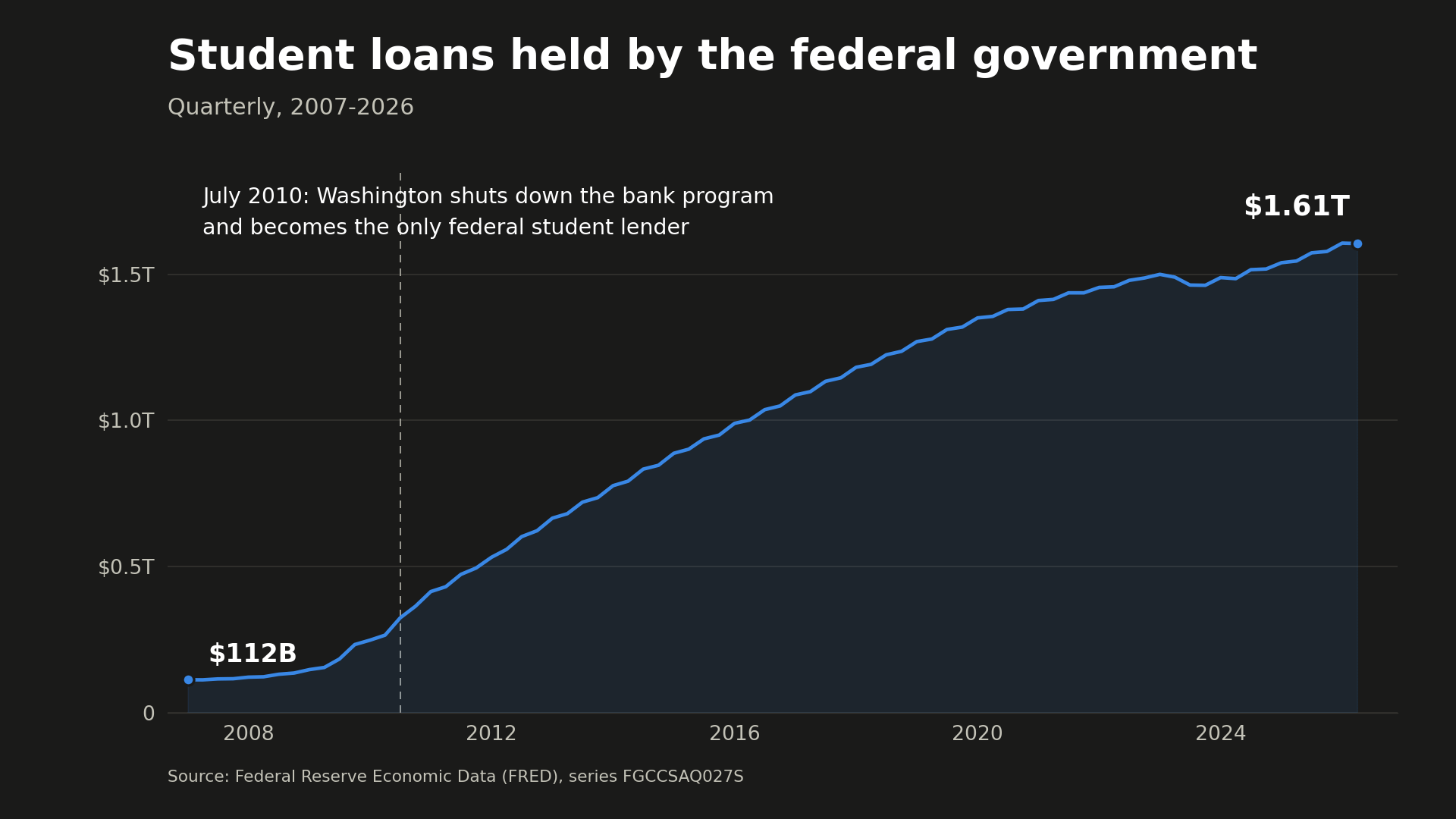
Washington held $112 billion in student debt in 2007. It holds about $1.6 trillion today. Source: Federal Reserve Economic Data, series FGCCSAQ027S.
Health care
Since World War II, the tax code has rewarded employer-provided insurance, which is why your coverage is tied to your job. Medicare and Medicaid poured trillions more into demand.
Now watch the supply side. About thirty-five states still make hospitals get a certificate of need — permission from the state — before they can build or expand.
Medicare doesn’t just pay for care. It decides how many new doctors the system is allowed to train on the federal dime. Congress froze that number in 1997. Raising it takes an act of Congress.
The state boards that decide who may practice medicine are staffed by practicing doctors — an arrangement the Supreme Court took a hard look at in 2015, when it ruled that a licensing board run by the people it regulates doesn’t get automatic antitrust protection. The body that accredits medical schools is co-sponsored by the American Medical Association, and most state boards make graduating from a school they approve a condition of your license.
So the people already inside the profession decide how many more get in. That’s what I’d call a government-sponsored trade cartel.
You’ve seen this structure before. It’s the planning board for doctors.
Twenty-seven states have pushed back a little, most of them only recently, by letting nurse practitioners treat patients without a physician looking over their shoulder. I helped pass that reform in my home state. The doctors’ lobby fights it every time.
So we capped the buildings, capped the doctors, and blocked other qualified, medically trained people from providing care. Then we acted surprised at the bill.
And the fix on offer is to put Washington in charge of even more of it with “Medicare for All” — the same move it made on student loans in 2010. Will see more of the same? I suspect so.
It’s all the same thing
Housing. College. Health care. Same recipe. Same result.
More democracy means more political decision-making over what gets built, which usually means less of it.
More experts means the decision goes to people farthest from the problem, who bear no consequences for failing to act. Again, it means less.
Eating the rich is popular, because envy is common. But it doesn’t create prosperity where poor people do better. It creates fewer rich people, while leaving the inflation that hammers everyone else untouched.
Democratic socialism wants to serve you a second helping of the poison destroying our country.
Young Americans are right to be angry. Most of you followed the script, did everything according to the best advice at the time, and the game feels rigged. Because it is rigged.
Let people build on their own land. Let builders build. When homes get built, prices stop outrunning paychecks, and you get your future back. Do the same in healthcare and education, and we get back to something approaching prosperity, abundance, and the American Dream.
The American Dream isn’t dead. It’s being blocked.


