


Photo by Spenser Sembrat on Unsplash
Kai Kahale drives a delivery truck in Honolulu. His wife, Leilani, works the front desk at a hotel in Waikiki. 2 kids and 2 paychecks. The kind of family that’s supposed to make it in America.
They rent a 2-bedroom apartment. In Hawaii, that runs about $2,000 a month, the highest in the country.
One year, Kai gets a raise. A good one. For the first time in a while, the family can breathe.
Then the lease comes up, and the rent goes up. Kai wasn’t the only one who got a raise. Half the building got one too. But the island has the same number of apartments it had last year, so there’s nowhere else for that money to go. The new rent eats the raise.
So the government steps in. A bigger tax credit. More money for groceries. Help with the rent. Each program comes with its own forms, its own office, and its own wait, and it all eats into what little free time two working parents have. But eventually, more money lands in the family’s hands.
Money doesn’t build an apartment, though. And the Kahales need a bigger one. The kids are growing.
So Leilani goes looking. There are a dozen families at the open house. They all got the same help she did. So they all bid on the same few homes, and the price climbs. The help comes in the front door and walks right out the back, straight into the rent.
Over nearly 40 years in Hawaii, rents climbed 52% after inflation. Incomes at the bottom climbed only 30%.
Kai and Leilani make more than they did 5 years ago. They get more help than they did 5 years ago. And they are no closer to getting ahead.
That’s what happens when you fight a shortage with cash. Everybody gets more money. The homes stay just as scarce. The only cure for a shortage is more of what’s short; we need to make more of what people need, and we need stable prices.
Both sides of the scale
This might sound strange coming from a conservative. But I care about poverty. I want working families to stop living paycheck to paycheck. The question is: how do we achieve this?
For 60 years, Washington has fought a war on poverty. And it has fought it one way: send more money. More food aid. More tax credits. More programs. Some of it helped. Some of it didn’t. A lot of it keeps being used fraudulently.
So what actually helps the Kahales? Property rights.
Think of poverty as a scale. On one side is what you earn. On the other side is what life costs. Washington has spent 60 years adding weight to the first side. But if costs pile up faster on the other side, you still lose.
Now the people who study poverty are starting to look at both sides too.
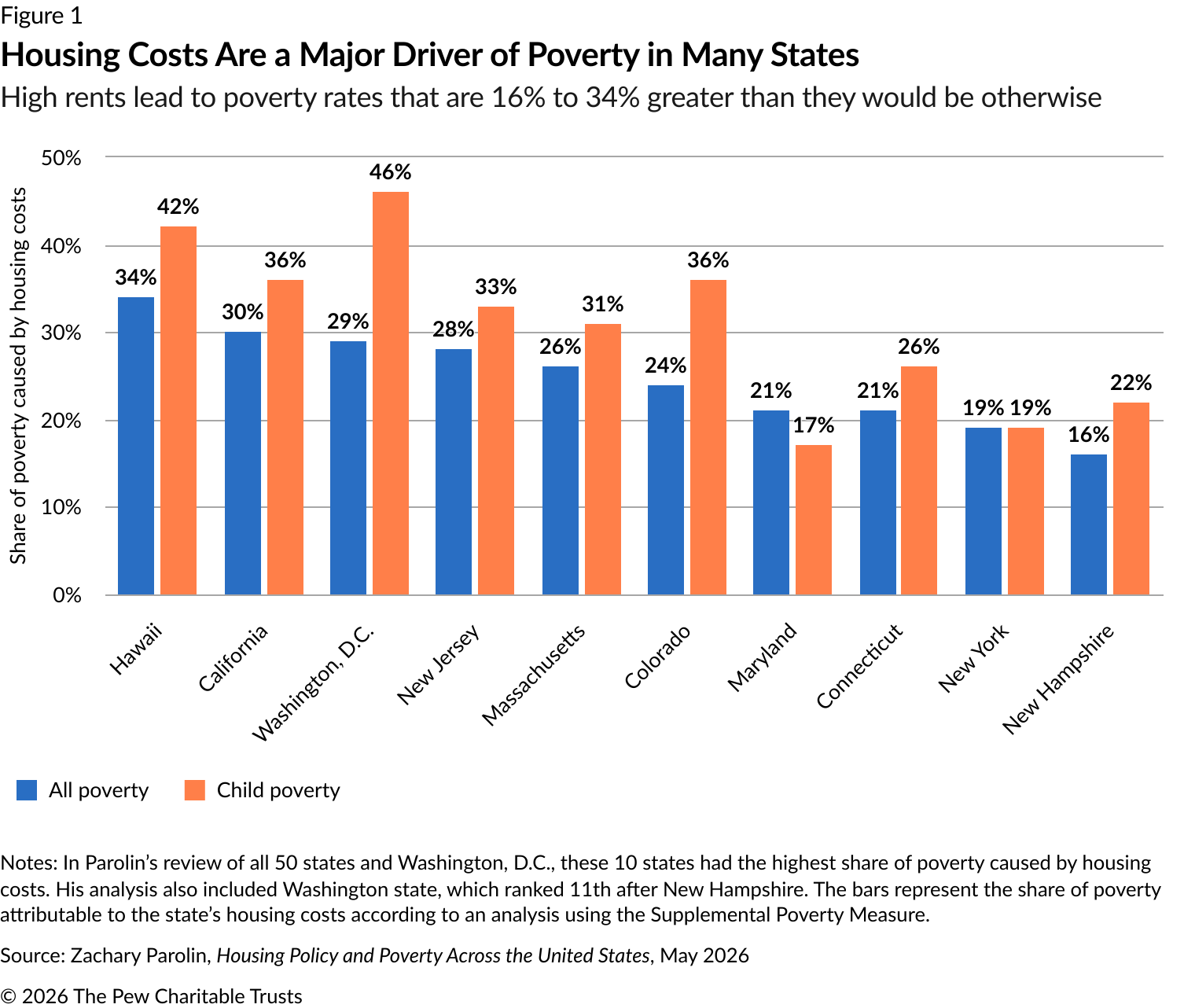
Last month, the Pew Charitable Trusts published new research by Zachary Parolin, a poverty expert at Oxford. He looked at the 11 states with the highest housing costs. Hawaii. California. D.C. New Jersey. Massachusetts. The usual suspects.
Then he asked a simple question. How much of their poverty comes from low pay, and how much comes from rent?
In Hawaii and California, rent drives about a third of it. In Washington, D.C., rent drives nearly half of child poverty.
Take the rent out of the math, and every one of those states drops below the national poverty rate. California has the highest poverty rate in America. Take out the rent, and it lands right at the national average.
A big piece of California’s poverty is really a rent problem.
Rent ate the food aid
From 1989 to 2023, federal food aid to these states grew by more than $30 billion, after inflation. Over the same years, rising rent raised the cost of escaping poverty by more than $17 billion.
Rising rent wiped out more than half of the new food aid. In California, it canceled out 78 cents of every new food-aid dollar. In New Jersey, 84 cents!
The Pew Charitable Trusts.
Washington sends the check. The rent goes up. The family ends up right where it started. Congress takes credit for compassion. The family stays poor.
That’s Kai and his family’s story but repeated across a whole state, a whole country. It’s a treadmill. Taxpayers and hard-working Americans keep running, but nobody moves.
Higher wages won’t fix it either. Look at D.C.
Over nearly 40 years, incomes at the bottom in D.C. grew 80% after inflation, one of the fastest rates in the country. But the city barely built. Its housing grew about a quarter in 40 years, one of the slowest rates in the nation. So the raises went straight to landlords. When nobody can build, the people who already own buildings don’t have to compete so they can charge more.
Cities that let people build
Austin, Texas, cut red tape and let homes go up. So did Minneapolis. In both cities, rents fell about 20% after inflation. Renters there save more than $4,000 a year compared to the national trend.
$4,000. Every year. No new program. No new agency. No vote in Congress.
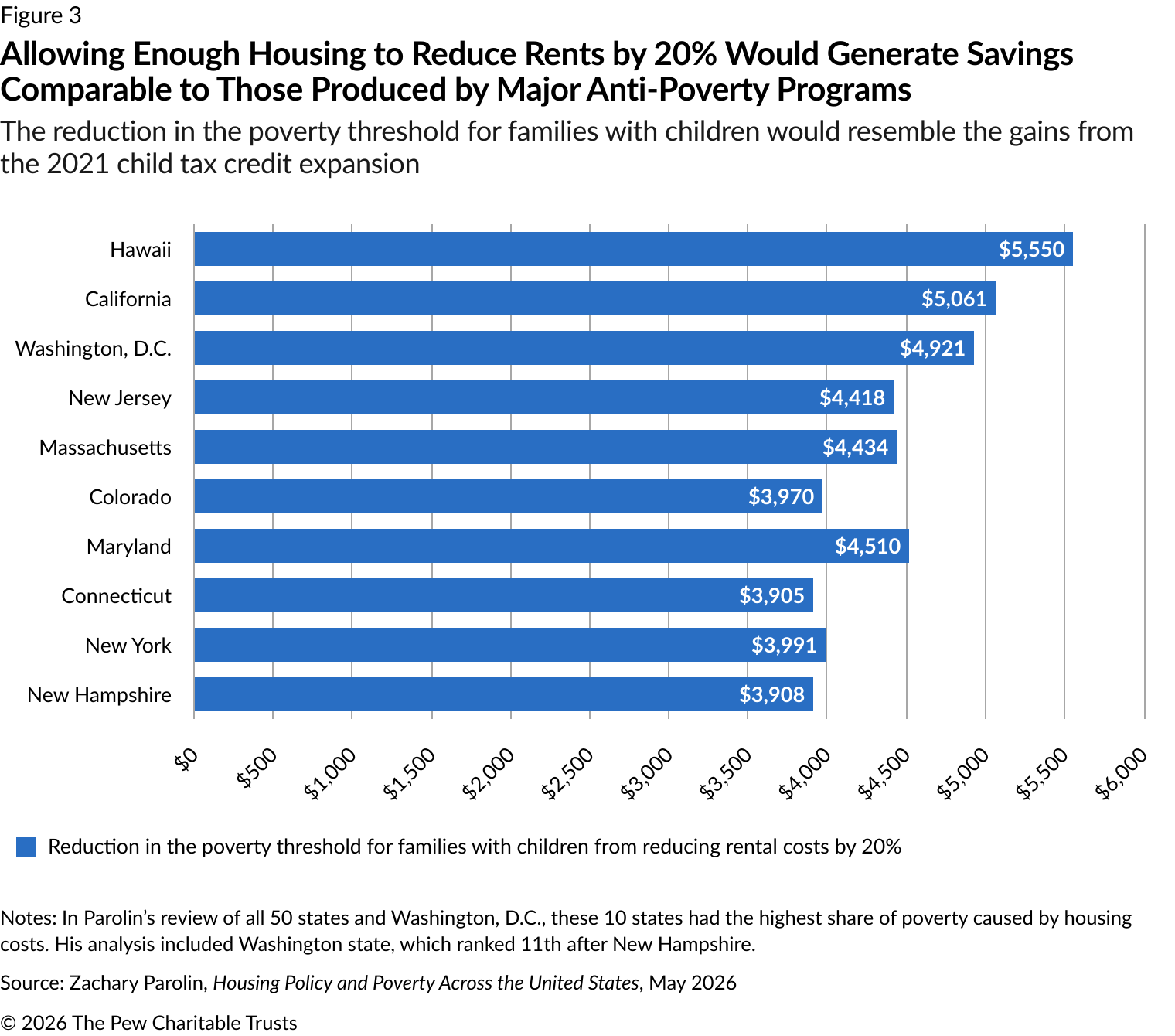
Parolin asked what a drop like that would do in the high-cost states. For families with kids, it would lower the poverty line by about $4,400.
The 2021 Child Tax Credit was one of the most expensive anti-poverty programs in years. It paid $3,000 to $3,600 per child. Lower rent beats it, per kid. And it costs taxpayers nothing.
The Pew Charitable Trusts.
The best anti-poverty program in America is a building permit.
So why don’t we do it?
Because we handed the job to someone else. The planning board. The zoning code. The commission, the council, the review panel.
The people on those boards aren’t villains. Most of them follow the rules they inherited. The rules and the system’s structure are the problems. And maybe even more so, the ideas behind them are the problem.
The rules tell you how big your lot has to be. How many parking spaces you need. How many homes you’re allowed. Whether your neighbor gets a vote on your house or redevelopment. Every one of those rules raises the price a working family pays for a home. In Hawaii, economists at the University of Hawaii estimate the rules add about $387,000 to the price of a new two-bedroom condo. That’s more than half of what the buyer pays.
Then the same government that made homes scarce spends billions helping people pay for them. That’s central planning. It sets the price of the biggest thing a family buys. Then it sends the bill to taxpayers.
There’s a better way. It’s our birthright as Americans: property rights.
Your land is yours. If you own a lot, you should be able to build a home on it. 2 homes. A duplex. A small single-stair apartment building. A place for your kid, your mom, a young family just starting out.
When people are free to build, homes get built. When homes get built, rents fall. When rents fall, the poverty line falls with them. And every dollar of help stays with the family, instead of padding the rent for landlords who never had to compete.
We’ve seen it work. Washington State nearly doubled its housing over 40 years. Today, rent drives only about 4% of its poverty, the lowest of any high-rent state Pew studied.
Back to Honolulu
Picture Hawaii letting people build.
New apartments go up near the hotels and the port. Duplexes go up on lots that used to allow one house. The families at Leilani’s open house have somewhere else to go. And landlords have to compete for tenants for a change.
Say rents fall 20% after inflation, like they did in Austin and Minneapolis. Kai and Leilani’s $2,000 apartment drops to about $1,600. That’s $400 a month back in their pocket. Close to $5,000 a year.
For a Hawaii family with kids, Parolin found the poverty line would drop by about $5,500. That’s more than the biggest child tax credit Washington ever paid per kid.
And this time, when Kai gets a raise, he keeps it, saves it, invests it, and builds his family with it.
That’s the new War on Poverty: fewer permission slips.
Give people back the right to build on their own land. You’ll do more for the working poor than any program Washington has dreamed up in 60 years.
Want to see it happen where you live? Go to your city council. Ask one question: what does it take to build a home here, and why?
Then subscribe, share this with someone who’s tired of paying more for less, and join us at buildtheamericandream.org.
The American Dream isn’t dead. It’s being blocked.
Sources
Pew Charitable Trusts, “The Housing Shortage Is a Major Driver of Poverty” (Sept. 29, 2026)
Zachary Parolin, “Housing Policy and Poverty Across the United States” (PDF)


