


Last year, Ruth Haddox was sleeping on her sister’s couch in Portland, Oregon. Single mother. Three kids. No job.
She did exactly what she was told to do. She put her name on the waitlist for subsidized housing. As a jobless mother of three, she figured she’d be near the top of anyone’s list.
Weeks went by. Then months. Then more than a year. Nobody called.
Here’s how Ruth actually got her family a home. She took a job at a doughnut shop. She opened a rental listings site. She found a three-bedroom house for $1,600 a month. She applied, and she moved in within a week. Her own summary: “This was way easier because the market had gone down.” (Wall Street Journal)
No caseworker. No income verification. No sitting across from a government office explaining your work history and your finances so somebody can decide whether you deserve help. A landlord had an empty house, Ruth needed one, and they made a deal.
The average income-restricted three-bedroom in the Portland metro rents for about $1,800, according to Yardi Matrix data cited by The Journal.
A private landlord beat the government program. On price and on speed.
The Journal ran her story on September 25 under this headline: “Portland Real Estate Is Such a Mess That All Housing Is Affordable Housing.”
A mess. A mother gets her kids out of a relative’s living room and into their own house in seven days, for less than the subsidized rent, and the paper of record for American capitalism calls it a mess.
So ask the obvious question. A mess for whom?
The bet Portland made
For most of the last decade, Portland ran on a simple theory. Rent only goes up. People without much money will never keep pace. So the only humane answer is for government to build subsidized units and put people on a waiting list once those units fill up. And they do fill up – usually – because who doesn’t want free money for your rent?
The city took that theory seriously. Portland declared a housing state of emergency in 2015. Voters then approved a city housing bond in 2016 and a regional Metro bond in 2018, worth hundreds of millions of dollars in total, to build income-restricted apartments.
That was a bad bet from the start. A subsidized apartment costs hundreds of thousands of dollars to build, takes years to open, and houses one family off a list. Meanwhile, the shortage underneath kept growing. When Tina Kotek took office as governor, the state estimated Oregon was short about 140,000 homes (KOIN).
Portland spent a fortune managing the shortage. Nobody in that system got paid to end it.
Only one thing ends a housing shortage: more homes.
What happened when Oregon built
Oregon added roughly 45,000 multifamily units between 2021 and 2025, concentrated in Portland and Bend, according to an analysis of Apartment List data published by the Portland Area Rental Owners Association.
Plenty of those were the new towers with rooftop decks and dog wash stations, the kind of building activists call “luxury housing” and show up at city council to stop. They matter anyway. When a buyer or renter with a six-figure salary moves into the new building, he leaves his ten-year-old apartment behind. Someone else moves into that one and leaves her older place behind. Down the chain it goes. Every new front door, even an expensive one, loosens up the whole city.
Build enough of them and the balance of power flips. Landlords stop picking tenants. Tenants start picking landlords.
That’s Portland now. The median rent on a new lease in the Portland metro fell 1.8 percent year over year to roughly $1,600, the largest drop among West Coast metros, per Apartment List data reported by Axios. Statewide, Oregon’s median rent posted its first year-over-year decline since 2020 (PAROA). Roughly 40 percent of Portland’s market-rate apartments now rent within 15 percent of nearby income-restricted units, according to Yardi Matrix, and new luxury buildings are offering months of free rent and still sitting partly empty.
People who qualify for income-assisted housing are competing with folks who earn six figures for a nice place to live because it’s affordable. That’s the “mess”? Seems like a good thing.
Why the subsidized apartment can cost more
There’s a second half to this story that almost never gets explained.
Subsidized rent in America doesn’t track what apartments actually cost. It tracks a formula. Most new subsidized rentals are financed through the federal Low-Income Housing Tax Credit, created by Congress in the Tax Reform Act of 1986 (HUD). Rent caps on those units are pegged to area median income. When local incomes rise, the ceiling rises automatically, whether or not anyone would pay that much on the open listing sites.
So in Portland, rents on regular apartments went flat because there were finally enough homes to go around. Rents on subsidized apartments kept climbing. Washington’s formula raised the ceiling every year, and many of those buildings raised their rents right up to it.
Just east of Portland, in Gresham, federal rules cap a tax-credit two-bedroom at $1,675 a month. Zillow puts a comparable unsubsidized apartment at $1,525 (Street Roots/OPB). In Gresham, the subsidized apartment is allowed to cost more.
Let’s get this straight. A program built to save poor families money. Allowed to charge them more than the listing across the street. After making them prove they’re don’t have the resources.
The investors get the tax credit. The developer gets a fee. The politician gets a ribbon to cut. Everybody in the deal comes out ahead except the family it was supposedly built for.
That family pays the premium. That’s government charity. That’s central planning: formulas control the outcomes; people and lives are just variables in steering the economy; results are a distraction because all that matters is the intention.
Population Decline
There’s reasonable pushback here, and it deserves a straight answer. People did leave Portland too.
Multnomah County lost 13,900 residents, about 1.7 percent of its population, between 2020 and 2024. It was one of only two Oregon counties with negative net migration over that stretch, losing 15,800 people to out-migration. The Portland metro as a whole also had negative net migration, and its small population gain came entirely from births outnumbering deaths (Oregon Employment Department).
So Portland had softer demand and a supply surge at the same time. The story isnt merely a question of supply. The real question is what else matters.
Demand in Bend went up. But Bend also built. The city went from fewer than 5,000 apartments before the pandemic to more than 8,000, and 2025 was on track to add more new units than any year in its history (Bend Bulletin). Rents spiked when remote workers poured in, peaking around $2,280 in August 2021. Then the new buildings opened. Today the median new lease runs about $1,750, down 23 percent from that peak (Apartment List). People didn’t stop wanting to live in Bend. Bend just built enough homes.
On the other side sits Eugene. Lane County issued fewer multifamily permits than almost any comparable market, and since January 2020 Eugene’s rents have climbed 26 percent, faster than the national increase of about 20 percent. Portland’s rose 2 percent over the same stretch (Apartment List).
This Oregon data tells an interesting story about the trade-offs of each policy and how dramatic the effects are. We have the same state laws, but localities are acting very differently in how they handle building. It shows that when you let people build, prices fall. Block building, and they climb. Build while people leave, as Portland did, and prices fall hard enough that a jobless mother of three can find a house on her own in a week.
Some will credit Oregon’s 2019 rent control law (a national first). I can’t see how it could take credit. The law caps rent increases at 10% a year at most, effectively helping only incumbent renters. When a unit turns over, the landlord sets any rent he wants, and buildings under 15 years old are exempt entirely and the rate cap doesn’t apply for 15 years for new construction. The rents that fell were new leases, like Ruth’s, in buildings like the new towers. Rent control doesn’t appear to have touched them since the market is experiencing a supply-and-demand deflationary wind.
Who actually thinks this is a mess
So why does the Wall Street Journal call it a mess? Because it talked to the people who run the old system, and for the old system this really is a crisis.
About 2,200 income-restricted apartments in Portland, 8.3 percent of the city’s subsidized stock, are sitting vacant. That’s the highest rate CoStar has ever recorded. Nonprofit owners are cutting staff, breaking loan covenants and selling buildings (WSJ).
In Northeast Portland, a new $53.8 million development built with tax credits and the regional housing bond struggled to fill studios and one-bedrooms whose restricted rents sat near market rate. Its operators started offering a month of free rent, according to the committee that oversees the bond (Street Roots/OPB). Nonprofit providers are now raising their marketing budgets to pull tenants away from private buildings.
$53.8 million, for apartments people didn’t want at the price the formula set.
This has landed in the housing debate in a revealing way. Quintin Mecke, who writes for a coalition of San Francisco affordable-housing nonprofits, answered the Journal with a concession: “The market worked for Ruth.” Then he added: “For a while.”
He makes two arguments. First, the subsidized buildings are failing because of a bad funding formula. He’s partly right, as I laid out above. Second, cheap rent can’t last, because builders stop building when rents fall. “Affordability, in market terms, is the failure condition,” he writes. His fix: transfer far more public money to nonprofits and let them hold the homes forever.
Convenient.
I want the same thing he does: a city where a family like Ruth’s has real choices. Where we part ways is his assumption that the rules causing the artificial scarcity are permanent. His case only works if zoning, permitting, fees, and a federal finance system that won’t lend into falling prices are all fixed facts of life. City councils, state legislatures, Congress and the Fed set every one of them, and every one can be changed. Yes, builders and their banks stop when rents fall below what it costs to build. But government sets much of that cost. Take property rights seriously, let builders work efficiently, make small homes legal again, and Ruth’s good month can become normal.
We’ve watched this play out before. When Congress stopped setting airfares in 1978, the old carriers warned that falling prices would wreck the industry. Real fares fell. Passenger traffic roughly tripled. Banks kept lending, because the airlines that learned to fly a seat cheaper than the fare were good bets. Flying went from a luxury to something a working family does every summer.
It happens across the economy. Economist Mark Perry tracks it in what he calls his “Chart of the Century.” From 2000 to 2025, the price of a TV fell more than 95 percent. Software, toys and cell phone service got cheaper too, while average wages rose 127 percent. Nobody calls the TV business a failure. Manufacturers kept building, kept competing and kept getting better at it, and they made money the whole way down. At the other end of Perry’s chart sit hospital services, childcare and college tuition, the sectors where licensing, mandates and gatekeepers decide who gets to produce and how. Their prices climbed faster than paychecks. Home building behaves like that second group. Its productivity has gone backward for fifty years, and the rules are a big part of why it can’t follow the TV down.
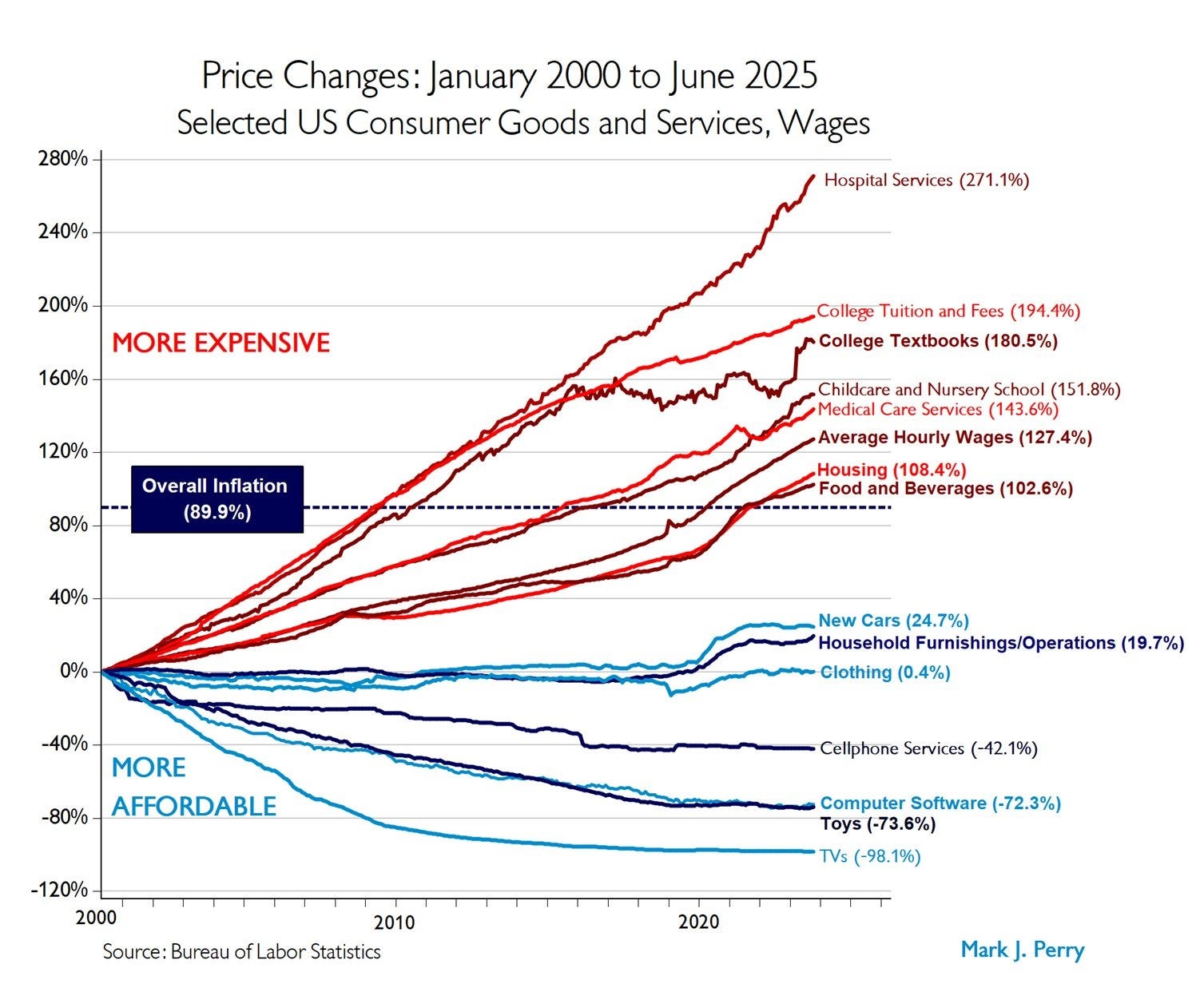
When producers are free to compete, and answer mainly for the harm they cause, they find ways to profit while prices fall. Especially when they can’t rely on “free” government money. Airlines did it. TV makers did it. American industry did it for most of the late 1800s, when prices drifted down for decades while output boomed. Home builders can do it too.
Let them, and Ruth’s good month becomes everyone’s status quo.
Portland is the proof
Portland just ran the experiment for the rest of us. You can spend decades and billions trying to subsidize your way out of a shortage. Or you can let people build until the shortage ends.
One of those put Ruth on a list. The other put her in a house.
Picture that in your town. A young couple, both working, opens an app and finds three places they can pay for and still save. A mom leaving a bad situation has somewhere to go by Friday. A landlord has to earn your business.
That’s a normal country. That’s the America your grandparents grew up in.
Let people build. The American Dream isn’t dead. It’s being blocked.


