


You lose your home in a fire. Everything you built. Your biggest asset. Gone in hours.
You’d expect urgency. The owners want their lives back. The city wants its tax base back. The country wants its people housed after a tragedy. We are the richest country in the world. We can do this, and do it quickly.
Instead, the waiting begins.
And it drags on. And on. And on.
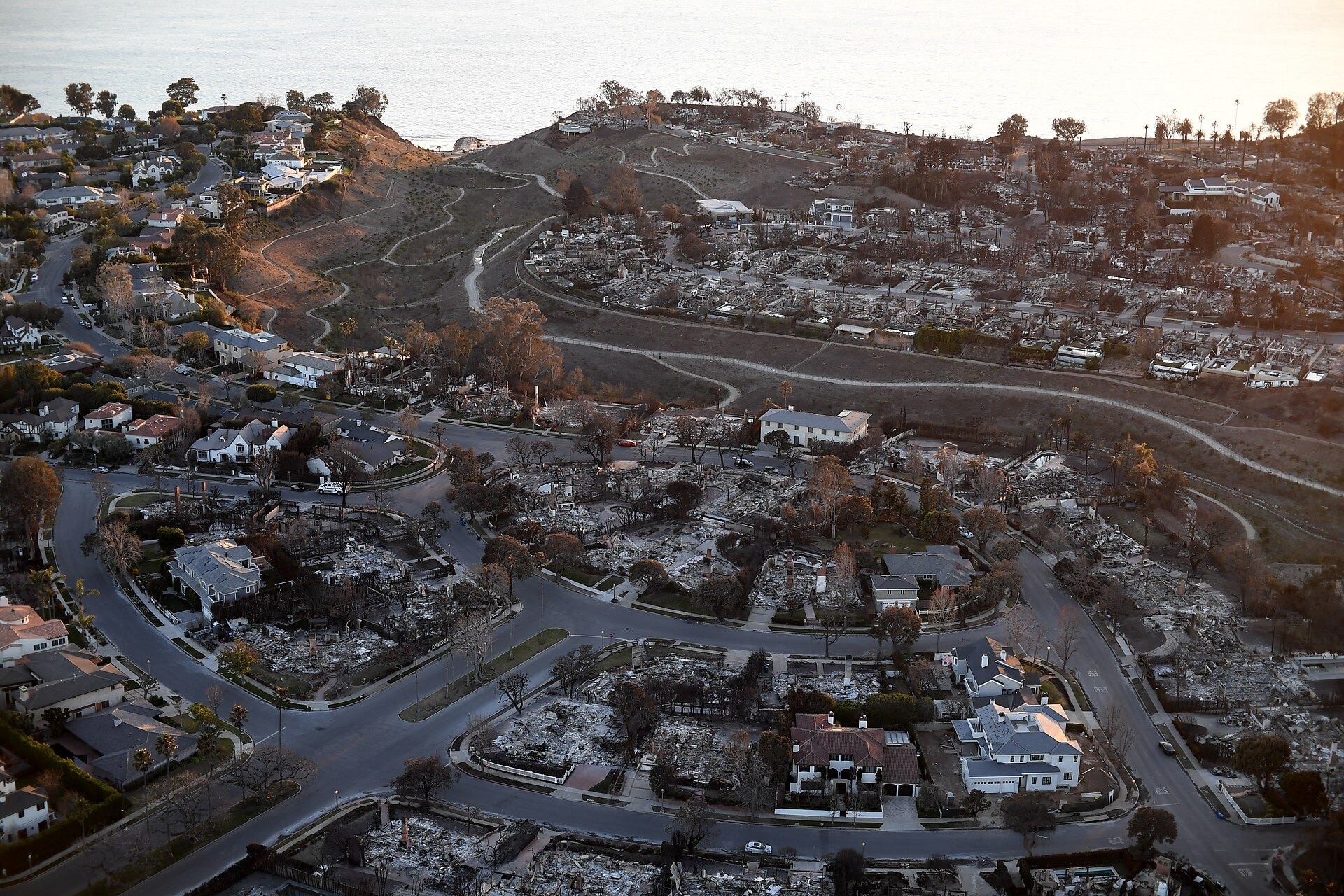
What Burned
The Palisades Fire started on January 7, 2025. Santa Ana winds drove it across 23,448 acres. It destroyed 6,837 structures. Twelve people died.
The fire was arson. Set by a 29-year-old man who, in July of the prior year, sat at his computer and prompted ChatGPT to generate, in his own words, a painting of “a burning forest” and a crowd of people “trying to get past a gigantic gate with a big dollar sign on it” — on the other side, “a conglomerate of the richest people, chilling, watching the world burn down, watching the people struggle, laughing, enjoying themselves, dancing.”
That is from the federal court documents of the prosecution.
It is a picture of the resentment-based politics we are drifting into as a culture. It cannot build anything. It can only burn.
Hold onto that. We’re coming back to it.

What They Got Right
The government did some things right after the fire. The Army Corps of Engineers cleared the lots ahead of schedule. Real credit where it’s due.
But the homes?
And Then, Nothing
The first family didn’t get a Certificate of Occupancy until November 21, 2025 — more than ten months after the fire. As of this spring, only a handful of homes have been finished and reoccupied across the entire burn zone.
A handful.
Out of nearly 7,000.
That is way worse than a slow start. Compare it to 1904.
Baltimore Did It Faster — In 1904
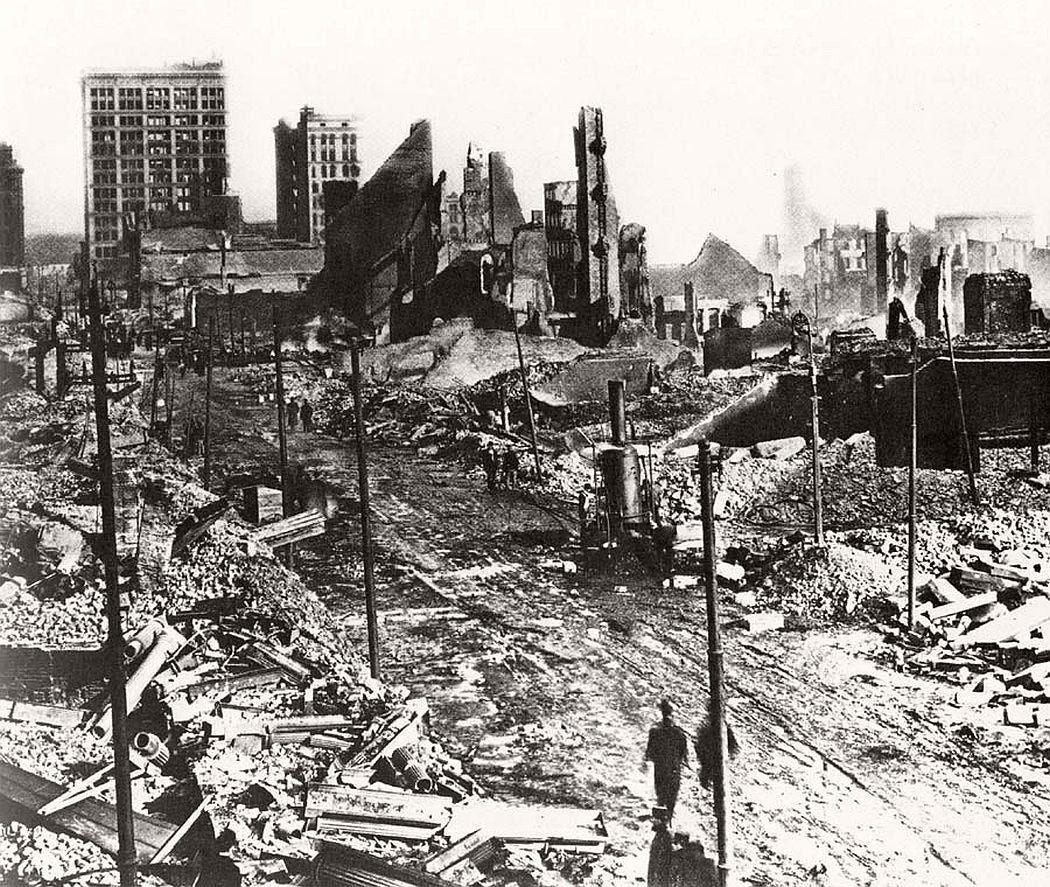
The Great Baltimore Fire destroyed 1,500 buildings across 140 acres of downtown. They did it without power tools, without cranes, without computers, with less wealth and fewer people than we have today.
The entire Burnt District was rebuilt and occupied in roughly two years.
We have more technology, more wealth, more people, more everything. And yet we cannot do in fifteen months what people in 1904 did with horses and hand saws. At the current rate, it will take roughly 500 years for the Palisades to become a lived-in community again.
This is the same permission bureaucracy that makes housing scarce in normal times. Now it’s preventing recovery from a disaster.
There are so many reasons it is taking forever throughout the process. Owners file permits. They hit design review. They face new studies on the exact same footprint that already had a house — though a little quicker. All the old rules still apply too; they weren’t all suspended. Things like minimum lot sizes and setback requirements still apply. You still gotta do extra reviews for that ADU. In fact, if you want to add that ADU, you are punished for not just rebuilding.
Yes, supply chains are tight. Yes, insurance is a fight — although that too is at least partly the government’s fault. But California’s rules are what turn a hard situation into a 500-year purgatory.
Temporary Mercy Is Not a Policy
Now — California did some things in response, yes. Newsom suspended parts of CEQA (their environmental review) and the Coastal Act for fire rebuilds. LA created a supposed “one-stop shop” for quicker reviews. The County tried an AI-assisted plan review pilot program.
Helpful. And not nearly enough.
Every one of those reforms is temporary. Every one of them treats permission as the default and freedom as the emergency exception. The fundamental problem is untouched.
And here is the deeper point. If property rights had been honored before the fire — if Californians had been free to build by right on their own land all along — the system would already be tuned for fast, owner-driven construction. The rebuild would not be a fifteen-month bureaucratic crawl followed by endless waiting for inspectors. It would be a sprint, run by the people who actually live there.
That’s how Baltimore, Chicago, and Boston rebuilt so much quicker.
The Last Locked Door
Remember — even after your plans are approved, even after construction is finished, even after the contractor walks off the job, the government still has one more checkbox. A separate sign-off by a separate government inspector. The house is built. The family is ready. And the door stays locked until a city employee finds time to come visit.
They call it a Certificate of Occupancy inspection. It seems to be one of the biggest bottlenecks in this process.
But there’s a solution for it. Florida has run a private provider program since 2002. A licensed architect or engineer, hired directly by the owner, signs off on plans and inspections. The system works just as well. But buildings get built faster. California could do the same tomorrow. This would dramatically expand the pool of people qualified to approve a house for occupancy while maintaining standards. Making it quicker and less painful for the family moving back.
That’s the lesson. Property rights and more open market-based systems don’t just help after a disaster. They prevent disaster from becoming a permanent condition by arranging the larger social structure to respond dynamically.
So if California is serious — really serious — about helping these families, the temporary suspensions aren’t enough. Make them permanent and respond with real policy change to empower Californians with property rights again. Cut the discretionary reviews. Restore the owner’s right to rebuild on her own land without asking permission from half the city.
Back to the Painting
Now — back to the accused arsonist.
He didn’t burn the Palisades because he was poor. He burned it because he had been taught, somewhere along the way, that the system was rigged, that the gate was locked, that the rich were on the other side laughing while everyone else struggled.
He was wrong about who to blame, and he did an evil thing by killing all those people and destroying so many lives. But he wasn’t entirely wrong that something was locked and deeply broken. How can you look at America today and conclude something isn’t deeply broken and disenfranchising?
The American Dream really is being locked away from millions of people in this country. Not by a cabal of billionaires in an Illuminati meeting. But by a permission system that says: you cannot build a starter home, you cannot put up an extra unit, you cannot rebuild your own house, or build those apartments unless some bureaucrat says so.
When you tell an entire generation that the dream is out of reach, and you build a system that makes it true, you give voice to the demons in the human soul that will justify any atrocity. We have been feeding that system — feeding those voices — with our politics and policy for decades.
We can do better. We must do better. Not just because the Palisades families deserve their homes back. Because a country that locks out its own people feeds resentment politics.
The answer is not to redistribute what already exists. The answer is to unlock the gate. Let people build. Let people own. Let people come home.
The arsonist gave in to despair. He believed the American Dream was dead and rich people were to blame. But it isn’t dead, it’s being blocked.
We can rebuild the American Dream. We can build again, and have a society defined by broad prosperity.
Let’s rebuild the American Dream together.


